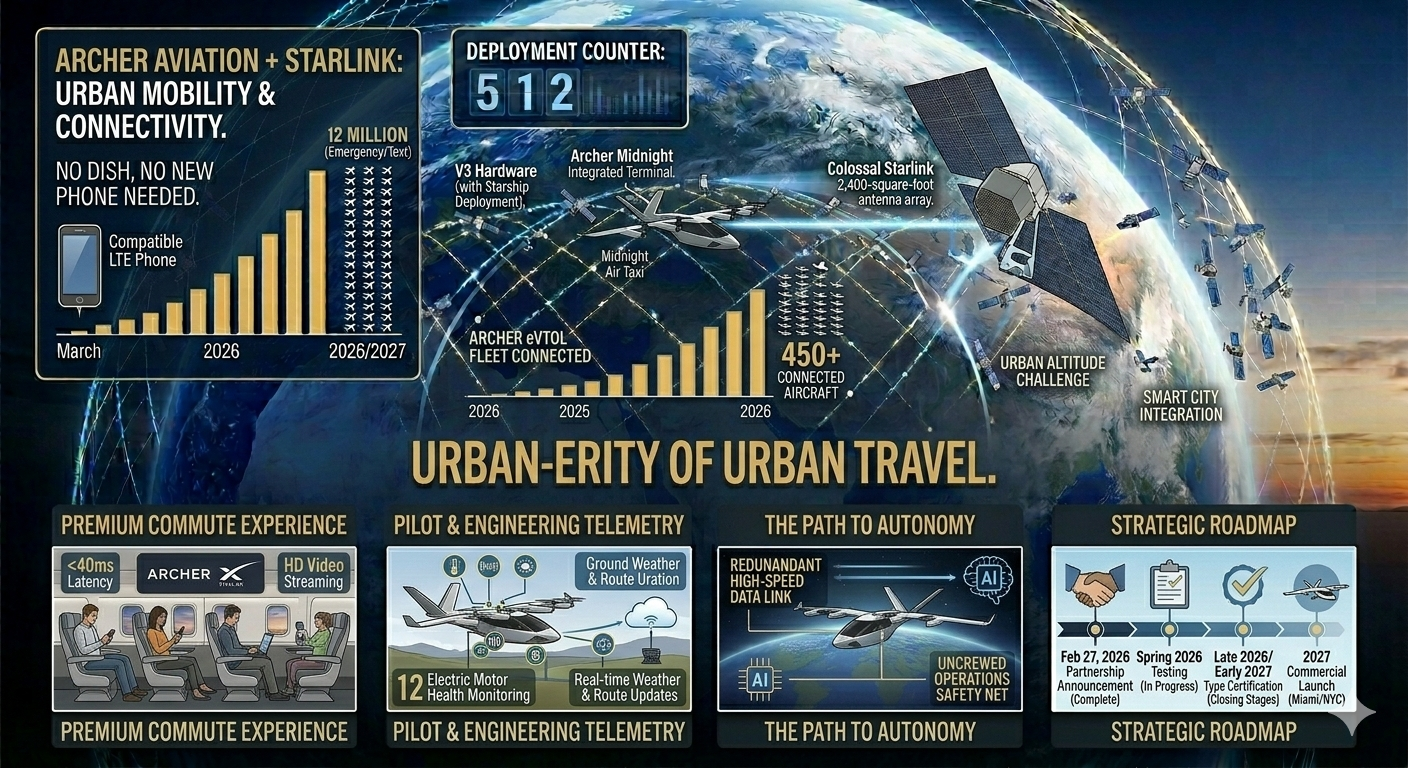
As of January 09, 2026, the “Void” of the digital divide is being filled by a web of light. With the Starlink constellation now surpassing 10,000 active satellites, the network has entered a state of “Awakening”—shifting from a simple internet provider into a foundational global utility that connects everything from the phone in your pocket to the air taxi in the sky.
Here is how the Starlink revolution is being reborn this month.
Page 1: The 10K Dashboard — A World Without Dead Zones
The milestone of 10,000 satellites, reached earlier this month, has fundamentally changed the “physics” of global connectivity. By saturating Low Earth Orbit (LEO), SpaceX has achieved a level of density that makes high-speed access a universal constant.
- The 480km Shift: SpaceX is currently repositioning 4,400 satellites to a lower altitude of 480km. This move reduces latency to sub-20ms levels and ensures that any decommissioned hardware de-orbits naturally within months, making the “Void” safer for future generations.
- Capacity Overload: With 10,000 units, Starlink has officially removed waitlists in nearly every market. The network is no longer just for “rural” users; it is now a viable primary competitor for urban broadband.
Page 2: 150Mbps Direct-to-Cell — The Mobile Awakening
On February 25, 2026, at the ITU Space Connect conference, SpaceX unveiled the next stage of its mobile evolution. The target: 150Mbps peak speeds delivered directly to unmodified smartphones.+1
- The $17 Billion EchoStar Catalyst: By finalizing the acquisition of EchoStar’s “golden” AWS-4 and H-Block spectrum, SpaceX now owns the “lanes” necessary to provide 5G-like speeds from space.
- The 2027 North Star: While current “text-and-SOS” services are active, the 150Mbps broadband tier is slated for a late 2027 rollout. This will allow for 4K video streaming and real-time AI processing on any phone, anywhere on Earth, without a satellite dish.
- V3 Satellites: To support this, Starship is now deploying V3 satellites equipped with 2,400-square-foot antennas—effectively turning the sky into a massive, global cell tower.
Page 3: Sky Mobility — The Future of Flight
The “Rebirth” of connectivity is most visible in the skies. This week, Starlink cemented its dominance in the aviation and emerging Urban Air Mobility (UAM) sectors.
- Archer Aviation Partnership: On February 27, 2026, Archer Aviation announced it will integrate Starlink into its Midnight electric air taxis. This ensures that passengers flying 1,500 feet above NYC or LA stay connected at 200+ Mbps, while providing pilots with a mission-critical data link for autonomous flight operations.+1
- Commercial Aviation Giants: * Lufthansa Group: Currently equipping its entire fleet of 850 aircraft with Starlink, with the first flights going live later this year.
- British Airways: Confirmed to launch its first Starlink-connected long-haul service in March 2026.
- United Airlines: Has already activated Starlink on 300+ regional jets, offering “Gate-to-Gate” Wi-Fi that never cuts out.