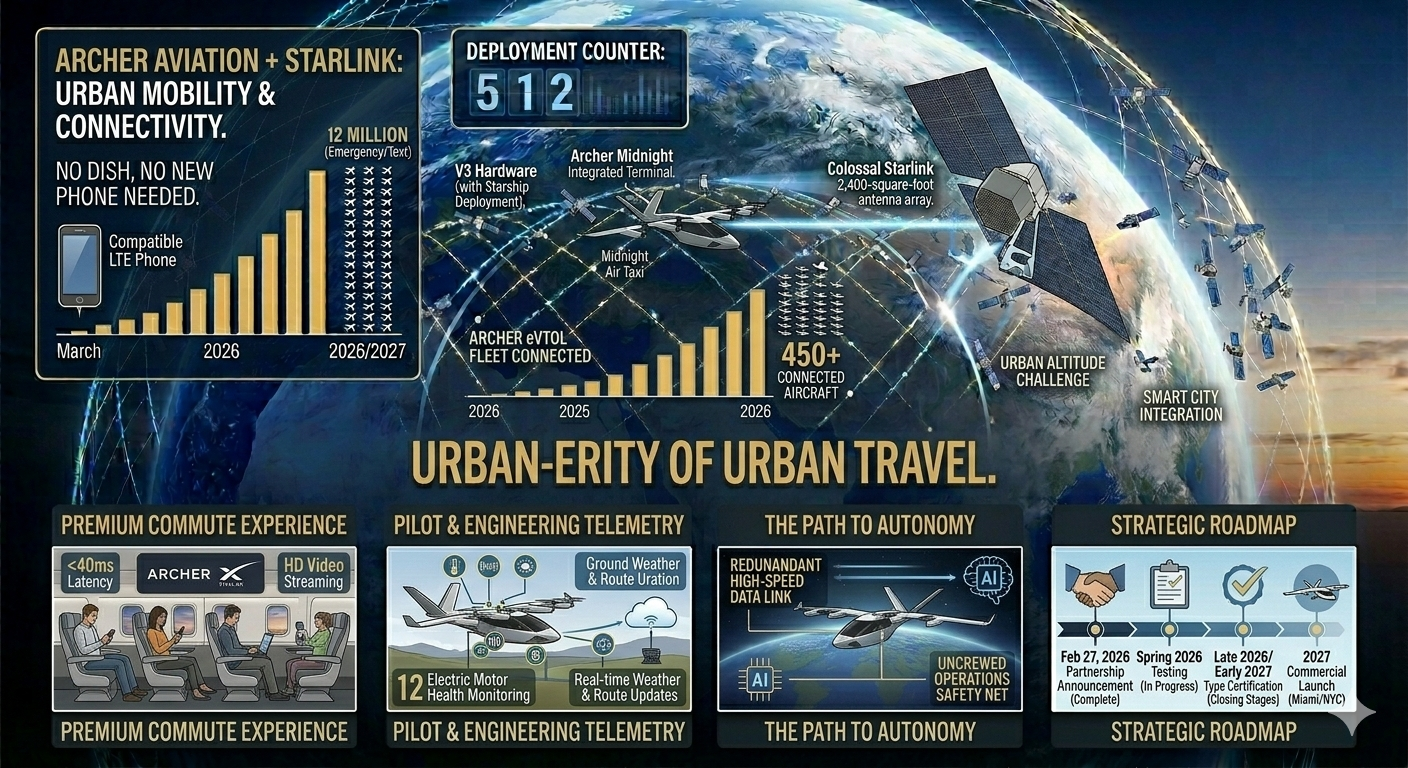
As of February 28, 2026, SpaceX has not just maintained its momentum—it has accelerated into a new bracket of orbital logistics. In the first eight weeks of this year alone, the company has successfully deployed 512 satellites, crossing the significant 500-satellite milestone during the Starlink 17-26 mission on February 25th.
This “warp speed” cadence has officially pushed the total number of active Starlink satellites past 10,000, solidifying its position as the largest and most dense artificial constellation in history.
The 2026 Launch Breakdown
February concluded with a “triple-header” finale, where three Falcon 9 missions launched from both coasts within a single week, adding 83 satellites to the mesh.
| Launch Date | Mission ID | Satellite Count | Launch Site |
| Feb 21, 2026 | Starlink 17-33 | 28 V2 Mini | SLC-4E, California |
| Feb 24, 2026 | Starlink 6-110 | 29 V2 Mini | SLC-40, Florida |
| Feb 25, 2026 | Starlink 17-26 | 25 V2 Mini | Vandenberg (500th of 2026) |
| 2026 Totals | 24+ Missions | 512 Satellites | Global Coverage Achieved |
Why 10,000 Satellites Matters
Reaching five figures in active spacecraft isn’t just a vanity metric. It represents a fundamental shift in network capacity and resilience:
- Inter-Satellite Laser Links: With 10,000 nodes, the laser mesh is now so dense that data can be routed around the globe entirely in space, bypassing congested ground-based fiber backbones with sub-20ms latency.
- Urban Density: The increased number of “overhead” satellites allows Starlink to serve high-demand urban markets that were previously “cell-limited,” moving closer to its goal of being a primary broadband competitor.
Next Phase: Starship V3 and the Gigabit Era
While the Falcon 9 continues its record-breaking reusability (with booster B1092 recently completing its 33rd flight), the “warp speed” of 2026 is merely the preamble to Starship V3.
- The V3 Awakening: As of February 27, Starship V3 Ship 1 (SN1) has moved to the launch pad for ground tests.
- Capacity Explosion: Each Starship launch is projected to carry over 60 Terabits per second (Tbps) of capacity—20 times more than a Falcon 9 batch.
- The 150Mbps Smartphone Goal: This month, SpaceX confirmed its 150Mbps Direct-to-Cell target, powered by the newly acquired $17 billion EchoStar spectrum. To achieve this, SpaceX has filed to launch an additional 15,000 VLEO satellites (at ~330km altitude) to act as high-speed cell towers in the sky.+1
Conclusion: No Signal, No Mercy
The message from SpaceX this February is clear: the era of the “dead zone” is over. With 512 satellites launched in 60 days and a constellation of 10,000+ now operational, Starlink is no longer just an “alternative” to cable—it is the new global backbone.